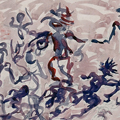
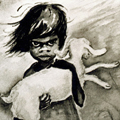
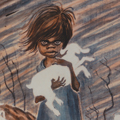
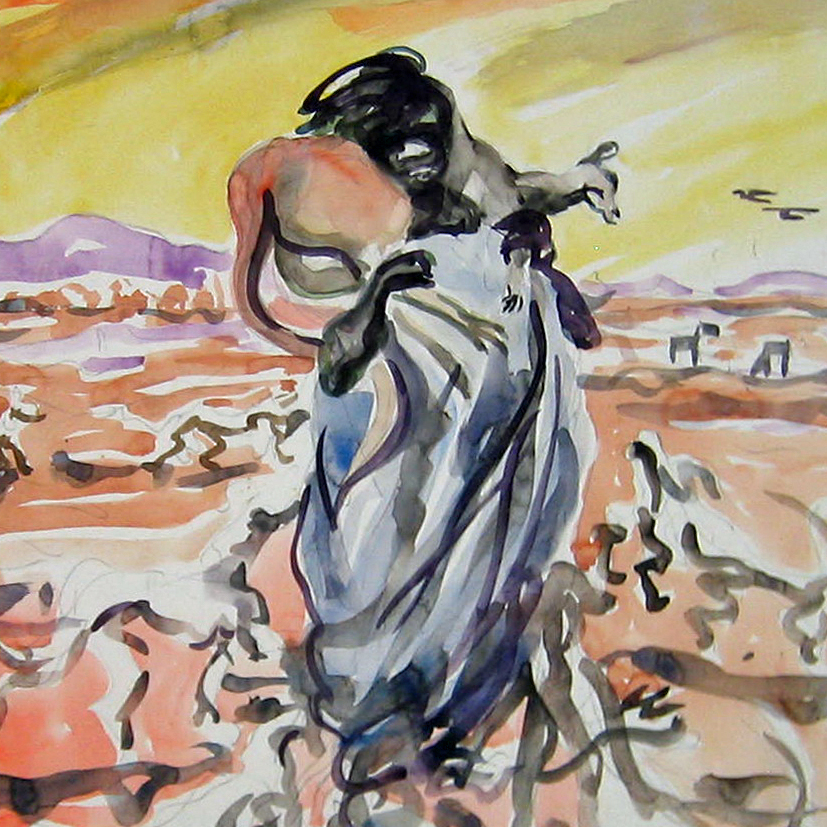
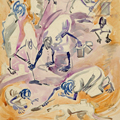
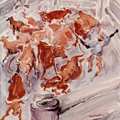
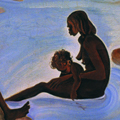
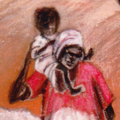
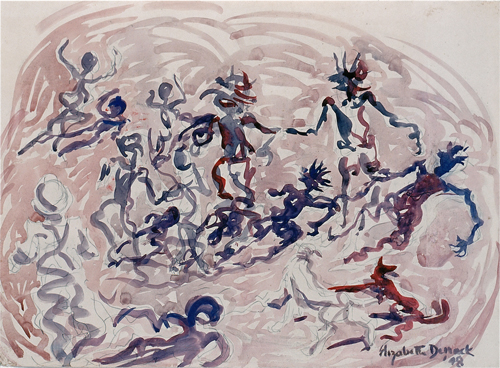
Prelude is the title of one of many watercolours produced between the years 1947–1950. The word refers also to a large number of paintings created when Elizabeth Durack, then in her early thirties, was honing her talent and setting a course for the future. The well-spring of the Prelude works is the artist's experience of northern Australia. Its dominant theme — the interdependence of human beings and land.
Inspired since childhood by the Kimberley region of north western Australia — where Durack had privileged access through long family association — and based after the war on remote Ivanhoe cattle station (where the town of Kununurra now stands) Durack was witness to the last phase of the region's early pastoral enterprise. Working alone, occasionally in company with Jubul — an artist from Arnhem Land — Durack aspired to record what she saw, and what she felt and understood: the impact of pastoralism upon the land and its original inhabitants. Her method is under-stated, uncompromising. The sense of movement, dominant in these and many later Durack works, alludes to escalating change.
Prelude paintings are in marked contrast to 'the gumtree school', interior portraits and still-lifes popular in Australia's art salons of the time. Determined to follow her own path, Durack was not diverted by fashionable art movements. The general mood of postwar Australia was optimistic and some notable contemporaries in Melbourne and Sydney were also breaking with tradition — Sidney Nolan, most famously, augmenting the myth of Ned Kelly ... Few then shared Durack's concern — or even took seriously that a woman would be concerned — with metaphysical aspects of life associated with the effects of settlement.
•
Most of the Prelude works displayed here were completed in a grass studio on the banks of the Ord River where Durack worked at night on a trestle table by the light of a hurricane lamp. Most days she would be walking in company with local Mirriuwong women and children, many of whom she'd known when younger. For long periods Durack lived in two very different worlds — at times experiencing traditions and beliefs that sustained a Stone Age people undergoing great change; at others, engaged in reading widely, thinking and acting creatively.
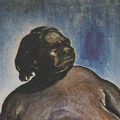
Along with lyrical watercolours of station life and landscape, Durack also produced a number of large oils on canvas swag covers — notably War and Peace, Ord River Venus, Ivanhoe Camp and Jubul.
All the paintings in Prelude are exterior works created from hundreds of field drawings. The one exception is Prayer an image of nuns observed from behind, heads bowed, facing the altar in the Beagle Bay church. In 1947 when Elizabeth first visited Beagle Bay, the mission was emerging from years of struggle. Affected by its ethos, by the Sisters of St John of God, the Pallotine priests and its many inhabitants she found respite and further inspiration. She visited Bungarun, the Leprosarium on the outskirts of Derby, and recorded in small sketches the Sisters selfless devotion to patients in their care. A set of Broome and Beagle Bay paintings, anticipating later work, is now part of the Collection of the Kimberley Sisters of St John of God Heritage Centre.
Labelled by some post-war critics as 'an artist with a social conscience', Durack dismissed this assessment, letters of the time attesting that her primary concern was aesthetics and with communicating a sense of interconnection between the past and the present and with all living and inanimate things. Notwithstanding the artist's claim that her choice of subject matter was incidental to the whole, some radical groups, weaving their own theories into her work, attempted to 'adopt' her; (the attempt was not successful.) Most metropolitan critics, finding no recognisable links or theory in her work, dismissed or disparaged it.
Undeterred by largely negative comment in places where it mattered, within four years Elizabeth Durack had held eleven solo exhibitions in major cities around the nation. By 1950 she was recognised as an artist of independent expression and ideas, outside of the mainstream — a position she maintained over the years.
•
Signature, a 3000 word essay written on Ivanhoe Station in 1948,is a personal manifesto about her art and life at the time. Extracts from it can be found here:
Signature
reflections on art, Ivanhoe Station, Kimberley WA, mss 1948